The linux kernel Is the core of the operating system. A full linux Distribution consists of the kernel plus a number of other software tools for file-related operations, user management, and software package management. Each of these tools provides a part of the complete system. Each tool is often its own separate project, with its own developers working to perfect that piece of the system.
While the most recent linux kernel ( and earlier versions ) can always be found in the linux kernel archives [ https://www.kernel.org ], linux distributions may be based on different kernel version. For example, the very popular RHEL7 distribution is based on the 3.10 kernel releases.
It Is imported to note that the kernel is not an all or nothing proposition for example RHEL 7 /CentOS 7 have incorporated many of the more recent kernel improvements into their older version, as have Ubuntu, openSUSE , SUSE etc..
Examples of other essential tools and ingredients provided by distributions include the C/C++ compiler the gdb debugger the core system libraries applications need to link with in order to run the low-level interface for drawing graphics on the screen, as well as the higher-level for installing and updating the various components, including the kernel itself. And all distributions come with a rather complete suite of application already installed.

Services Associated with Distributions
The vast variety of Linux distributions are designed to cater to many different audiences and organizations, according to their specific needs and tastes. However, large organizations, such as companies and governmental institutions and other entities, tend to choose the major commercially- supported distributions from Red Hat, SUSE, and Canonical (Ubuntu).
CentOS is a popular free alternative to Red Hat Enterprise Linux (RHEL) and is often used by organizations that are comfortable operating without paid technical support. Ubuntu and Fedora are widely used by developers and are also popular in the educational realm. Scientific Linux is favored by the scientific research community for its compatibility with scientific and mathematical software packages. Both CentOS and Scientific Linux are binary-compatible with RHEL; i.e. in most cases, binary software packages will install properly across the distributions.
Many commercial distributors, including Red Hat, Ubuntu, SUSE, and Oracle, provide long term fee-based support for their distributions, as well as hardware and software certification. All major distributors provide update services for keeping your system primed with the latest security and bug fixes, and performance enhancements, as well as provide online support resources.

NOTE:
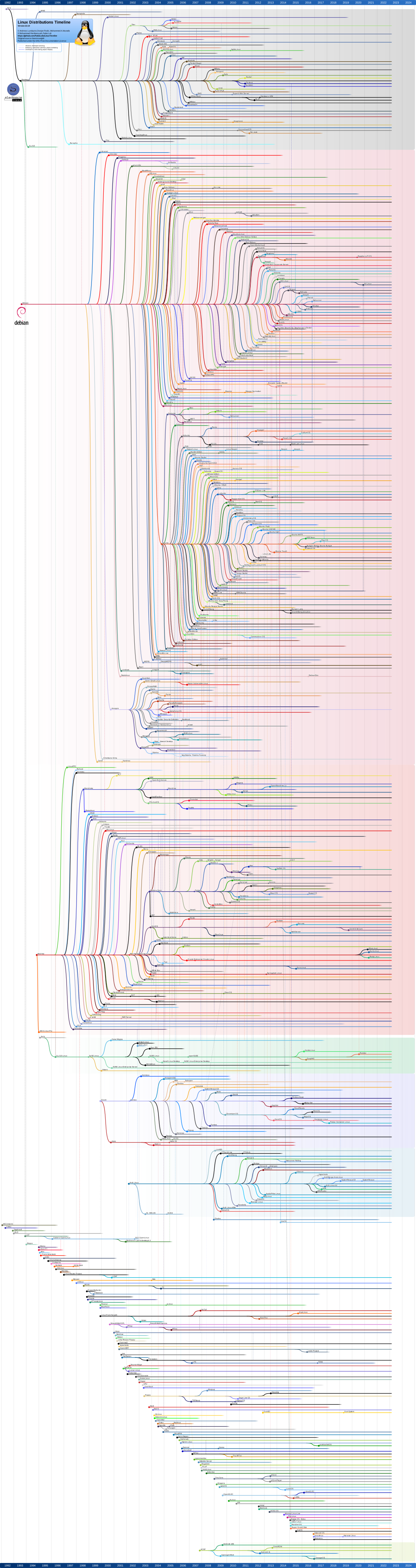
linux distro tree :
https://upload.wikimedia.org/wikipedia/commons/1/1b/Linux_Distribution_Timeline.svg
Lean wiki :
https://en.wikipedia.org/wiki/List_of_Linux_distributions
Comments
Post a Comment